3rd: fifth level above the street (ground floor, principal, 1st, 2nd, 3rd).
Home
107 m² built, according to the Cadastre (Catastro)
Windows
Onto Calle Marina (south-west) and onto the lightwell (north-east)
Issued
30 October 2026 · report AS-0001
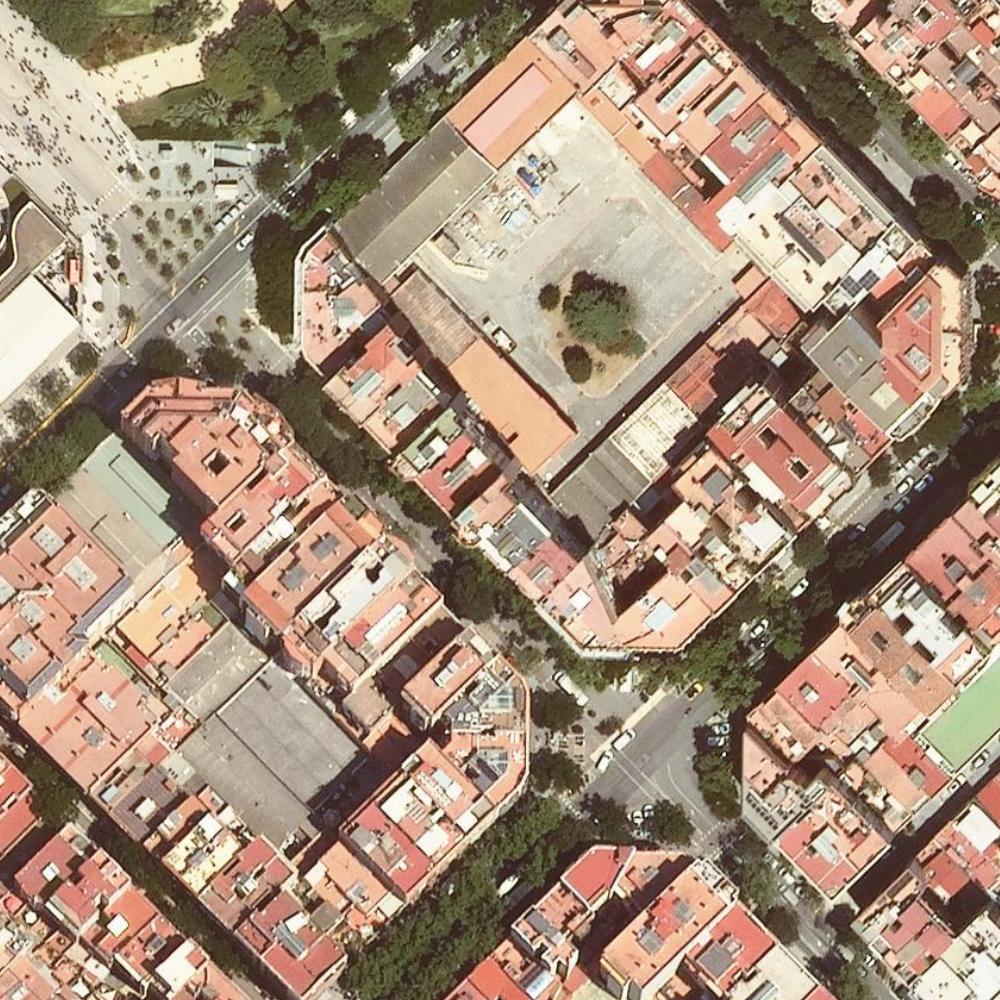
ICGC orthophoto 2025
In short
The window facing Calle Marina gets the most direct sun: 1,469 hours a year, twice as much as the window facing the lightwell (668 h).
In its favour
1,469 hours of direct sun a year at the window facing Calle Marina, with 3 h 31 min on 20 March. See the sun
Roof terrace: it has sun at lunchtime in winter (100% of the time, 2 to 4 pm), when it's most welcome. See the sun
Outside the official 10, 100 and 500-year flood zones in Barcelona. See the risks
Worth bearing in mind
The window facing the lightwell gets no direct sun in December. That is not darkness: the light of the sky still comes in. See the sun
The building is inside the low-emission zone “ZBE Rondes de Barcelona” (Barcelona): it restricts access for vehicles without a label (A). See the neighbourhood
1 tourist-use flat is registered in the building. See the building
The block measured with LiDAR and the aerial photo, with the real sun at each window. Pick a window and a day, and drag the time to see when the sun comes in and what blocks it.
Window or terrace
Day5 h of direct sun on 21 June
Time06:20
Direct sun at each window
Real data · calculated
Minutes during which direct sun, with nothing in the way, lights the centre of the window from outside. Clock time, with daylight saving applied.
We measure direct sun, not daylight. Without direct sun, a room can still have good natural light: the light of the sky comes in anyway. A window onto a wide street or a spacious courtyard often has good light even without direct sun.
Window onto Calle Marina
Faces south-west, towards the buildings across the street.
1,469hours of direct sun a year
Some direct sun in winter
Daylight, not direct sun
Sees part of the sky: moderate daylight is likely, even with little direct sun.
21 December2 h 39 min10:30–12:49 · 13:37–13:59
20 March3 h 31 min11:36–15:07
21 June5 h13:40–18:40
6:0010:0014:0018:0022:00
Direct sun (stronger colour, more days)Daylight, no direct sunNight
Solar heat on the glass
How much sun the window gets, not the temperature inside the flat.
July · Moderate solar heat in summer2.4
January · Some sun in winter1.3
kWh per m² of glass, on an average day
On an average July day the glass receives 2.4 kWh/m², and 1.3 kWh/m² on an average January day.
On an average July day, 1.6 h of direct sun coincide with a street above 28 °C.
Window onto the lightwell
Faces north-east, onto a light well.
668hours of direct sun a year
No direct sun in winter
21 DecemberNo sun
20 March1 h 52 min8:04–10:02
21 June3 h 58 min7:55–11:53
6:0010:0014:0018:0022:00
Direct sun (stronger colour, more days)Daylight, no direct sunNight
Solar heat on the glass
How much sun the window gets, not the temperature inside the flat.
July · Low solar heat in summer2.1
January · Little sun in winter0.3
kWh per m² of glass, on an average day
On an average July day the glass receives 2.1 kWh/m², and 0.3 kWh/m² on an average January day.
On an average July day, 0.7 h of direct sun coincide with a street above 28 °C.
The measured terrain is from 2022. We have added what was finished afterwards and changes the sun in this area (Sagrada Família: its central towers, up to 172.5 m) at their official height with an approximate shape.
In a narrow lightwell the calculation is indicative: nearby walls are harder to measure.
According to the Cadastre, within 100 m there's a building from 2022. It's newer than the relief survey (2022) we use to calculate the sun: the calculation may not see it. If it's in front of your windows, check its shadow at the viewing.
What this means and what it doesn't
This is how much sun reaches the window, not the temperature of the flat: we do not know the size or type of glass, or whether there are awnings, shutters, insulation or air conditioning. The temperature is the area's (ERA5, cells of about 25 km), not the street's: on the coast it falls short.
Compared with the CTE. Spain's building code (CTE DB-HE) limits July solar gain in new homes to 2.00 kWh per m² of floor area per month, with solar protection in place; it cannot be compared with these figures, which are per m² of glass and without protection.
The marks on the bars show where the medium and high levels start in July (2.3 and 3.7) and the high level in January (2.5).
What it's based on. A 3D model of the whole block, at centimetre scale, and the sun's position minute by minute throughout the year. Typical margin: ±5 min a day.
Each clock is what the window sees. The edge is the horizon and the centre, the highest point of the sky. In slate grey, the buildings and trees that block the sky. The arc is the path of the sun on 20 March; the Roman numerals mark where it is each hour, in rust red when it shines on the window.
Roof terrace
The sun where you would sit: on the balcony, terrace or roof you chose. It is measured like a window, but at the spot where you sit or lean out, and it is also counted for mealtimes.
Roof terrace
Flat roof: it sees the whole sky, with north at the top.
3,798hours of direct sun a year
A lot of direct sun in winter
At lunch and dinner time
Share of the time with direct sun in that window, by the clock.
100%
Sun at lunchtimeIn summer · 14:00 to 16:00
100% of the time
0%
Sun at dinner timeIn summer · 20:00 to 22:00
0% of the time
100%
Sun at lunchtimeIn winter · 14:00 to 16:00
100% of the time
21 December8 h 19 min8:27–16:46
20 March10 h 33 min7:02–17:35
21 June11 h 37 min6:44–18:21
6:0010:0014:0018:0022:00
Direct sun (stronger colour, more days)Daylight, no direct sunNight
Solar heat in this space
July · High solar heat in summer6.8
January · Welcome winter sun2.2
kWh per m² of horizontal surface, on an average day
On an average July day, the roof terrace receives 6.8 kWh/m² and, on a January one, 2.2 kWh/m².
On an average July day, 3.0 h of direct sun coincide with a street above 28 °C.
Where it is measured and how to read the heat
The sun is measured at a single point: 1.5 m from the facade and 1.2 m above the floor, like a person sitting or leaning out; on the roof, at the centre of the roof. We cannot see the real depth of the balcony or the balcony of the flat above.
This is the sun the space receives, not its temperature: it does not count awnings, plants or parasols. A roof gets the sun on a horizontal surface, so its figures and levels cannot be compared with those of a window. On the roof, which gets the sun on a horizontal surface, the marks show where the medium and high levels start in July (4.0 and 6.5) and the high level in January (2.0).
Noise on the façade
Real data
At night, the façade onto Calle Marina gets the noise of a street with quite a lot of traffic (60–64 dB). That is above the 45 dB at night the WHO recommends.
At night, the façade onto the lightwell gets very low noise, below that of a quiet street (35–39 dB). That is below the 45 dB at night the WHO recommends.
Inside, with the windows closed, you hear quite a lot less.
Façade onto Calle Marina
65–69 dB by day60–64 dB at night
50 dBquiet street60 dBconversation, street with traffic70 dBbusy avenue
Façade onto the lightwell
45–49 dB by day35–39 dB at night
50 dBquiet street60 dBconversation, street with traffic70 dBbusy avenue
Where the decibels come from and what they don't say
Level from the 2022 strategic noise map 1–3 m from each façade, in 5 dB bands: daytime (7 am to 9 pm) and night-time (11 pm to 7 am). It's a model of traffic and other sources, not a measurement in the flat; closed windows reduce it a lot.
In ochre, the home in this report. In dark grey, the commercial unit.
Energy certificates
In this building, 2 homes or premises have a registered energy certificate (2018 to 2026); most of them, consumption letter E. We couldn't find this flat's certificate: ask for it, it's mandatory to sell or rent.
A
B
C
D
2E
F
G
Certificate of occupancy (cèdula d'habitabilitat)
Whether the flat holds a valid certificate, and how many usable square metres it recognises, is shown by the search tool of the Agència de l'Habitatge de Catalunya. We don't report it ourselves because its register can't tell a home without a certificate from one that simply isn't listed. Search by cadastral reference: 1240526DF3814A0005BT.
MasOrange (Orange, Jazztel, MásMóvil, Yoigo)Fibre · up to 1,000 Mbps · own network
MovistarFibre · up to 1,000 Mbps · own network
VodafoneFibre · up to 1,000 Mbps · own network
Mobile, in the street
4GMovistar, Orange, Vodafone and Yoigo (MásMóvil)
5GMovistar, Orange and Vodafone, up to 500 Mbps
This is the coverage the operators report to the Ministry as of 30/06/2024. Mobile coverage is measured in the street: inside the flat, especially on inner or ground floors, it can be worse. Fibre on the plot doesn't mean the flat has the socket installed. Origen de los datos: Ministerio para la Transformación Digital y de la Función Pública.
Tourist flats
1
In the buildingRegistered
1 tourist-use flat is registered in the building (8 beds).
47
Within 100 mRegistered
Within 100 m of the building, 47 tourist-use flats are registered (206 beds).
21
In the census tractListed on platforms
The INE counts 21 tourist flats advertised on platforms in its census section (2.2% of its homes, 81 beds), as of May 2026.
"Registered" means entered in the region's tourism register: flats let without registration do not appear. They are matched by the building's address: an entrance with a letter or bis can be confused with the next one. The floor and door are compared with the register's: if it writes them differently, a match can be missed. The INE figures are platform listings, registered or not.
Ajuntament de Barcelona, Open Data BCN: Habitatges d'ús turístic. CC BY 4.0.
INE, estadística experimental de viviendas turísticas. CC BY 4.0.
Source of the building data
Source: Dirección General del Catastro, consulted 30 Oct 2026 (reference 1240526DF3814A).
The air of this street has moderate pollution, mostly from traffic: it meets today's legal limit, but not the stricter one that applies from 2030.
The WHO 2021 guideline is a health reference, stricter than the law, and here it is exceeded for NO₂, PM2.5 and PM10.
µg/m³, annual average
NO₂
Nitrogen dioxide, mostly from traffic
20–30Street · street section20.4Area · 1 km model
WHO2030today
WHO 2021 guideline (reference only)10 µg/m³· exceeded by about 15 µg/m³
EU limit from 2030 (not yet in force)20 µg/m³· exceeded by about 5 µg/m³
Legal limit today (EU)40 µg/m³· met
PM2.5
Fine particles from traffic, combustion and industry; they reach deep into the lungs
15–20Street · street section10.4Area · 1 km model
WHO2030today
WHO 2021 guideline (reference only)5 µg/m³· exceeded by about 13 µg/m³
EU limit from 2030 (not yet in force)10 µg/m³· exceeded by about 8 µg/m³
Legal limit today (EU)25 µg/m³· met
PM10
Slightly coarser airborne particles, from traffic, building works and dust
20–25Street · street section20.4Area · 1 km model
WHO2030today
WHO 2021 guideline (reference only)15 µg/m³· exceeded by about 8 µg/m³
EU limit from 2030 (not yet in force)20 µg/m³· exceeded by about 3 µg/m³
Legal limit today (EU)40 µg/m³· met
Nearest monitoring station
Barcelona (Gràcia - Sant Gervasi)Traffic station, urban, 2 km away, 2025 averageNO₂ 25 · PM2.5 12 · PM10 23 µg/m³
Where the data comes from and what it does not say
The area value comes from an official model with 1 km cells: it describes the air of the neighbourhood, not at the door; next to a busy road, NO₂ can be considerably higher. The references are the 2021 WHO guidelines, the limit the EU will apply from 2030 (Directive 2024/2881) and the one in force today. A figure less than 10% above a limit is called "close": that is less than the error of a model. For the flat's street, the 2024 map by Barcelona City Council and the Barcelona Public Health Agency takes precedence: it is per street section, in concentration bands, and it includes the street's traffic. A monitoring station gives a measured value (annual mean), but it describes where it stands, not the flat.
Fuente de los datos: Ajuntament de Barcelona y Agència de Salut Pública de Barcelona, mapas de inmisión de la calidad del aire por tramo de calle (CC BY 4.0).
Outside the official flood zones for return periods of 10, 100 and 500 years.
Radon potential of the area: P90 between 201 and 300 Bq/m³ (Spanish Nuclear Safety Council). The reference level in Spain is 300 Bq/m³; it matters most on ground floors and basements.
Detail by return period
Flood
At this building
Frequent: once every 10 years on average
the water doesn't reach it
Occasional: once every 100 years on average
the water doesn't reach it
Exceptional: once every 500 years on average
the water doesn't reach it
What the official maps cover and what they don't
The official maps cover the stretches of river and coast with significant risk. Outside them there's no study: it's no guarantee that it won't flood.
Planning
Real data
Land class
Consolidated urban land
Plan in force
Plan General (1976)
Zone
13a
Zoning
Densificació Urbana Intensiva
Zone 13a of the municipal plan (Densificació Urbana Intensiva); in Catalonia's common classification, “Residencial, Urbà tradicional”.
Scope of this planning summary
A summary of the planning, for information only. For building work, changes of use or permits, ask the town hall for the planning certificate (cédula urbanística).
Nearby on foot
Real data
Getting around
Metro · Mallorca / Marinalines L2 and L5L2L5
2 min
Train or tram stop · Sicílialine T4T4
7 min
Bus stop · Mallorca - Marinalines 19, 33, 34, D50, H10, N1, and N9193334D50H10N1N9
2 min
High-speed rail · Barcelona Sants
4.1 km
Everyday
School · Escola Ramon Llull
5 min
Health centre · Centre d'Atenció Primària Roger de Flor
Walking times estimated from the straight-line distance × 1.3, at 4.8 km/h. OpenStreetMap data: places may be missing or out of date. Supermarkets: chain stores; if there is none nearby, the nearest grocery shop. Health: hospitals and public health centres.
The building is inside the low-emission zone “ZBE Rondes de Barcelona” (Barcelona).
ZBE Rondes de Barcelona · Barcelona
In force
Access restricted to
Vehicles without a label (A): access restricted since 1 January 2020. Cars and motorcycles without a label (in general, petrol older than Euro 3 and diesel older than Euro 4). Vans from 1/4/2021; lorries and light buses from 1/1/2022; heavy buses and coaches from 1/7/2022.
Hours
Monday to Friday, 7:00 to 20:00.
The ZBE was suspended and came back into operation on 16 March 2026, according to the notice on the official site.
Exceptions
Daily pass (up to 24 authorised days of driving a year), vehicles of people with reduced mobility and emergency or essential services. Foreign-registered vehicles must prove they comply. No exception for residents is listed.
Punto de Acceso Nacional de la DGT (CC BY 4.0), published on 30 July 2026.
Town halls' ordinances and pages (reviewed by Asoleo), 19 October 2026.
Prices in the area
Real data
Estimated rent for this flat (107 m²)
1,800 €/month · 1,530 to 2,220
Rent per square metre in the la Sagrada Família neighbourhood (new contracts, 2T 2025–1T 2026)
16.8 €/m²
Median rent in the municipality (2024)
900 €/month · 736 to 1,169
New contracts in the municipality (January–March 2026)
1,137 €/month
Average appraised value (second quarter of 2026)
4,602 €/m²
Stressed residential market area
In a stressed zone
The municipality of Barcelona is declared a stressed residential market area (Catalonia), valid from 16 March 2024 to 15 March 2027.
In a declared area, new residential leases may have their rent capped according to the reference index and the rules of Law 12/2023: large landlords (here, anyone owning 5 or more urban residential properties) are held to the index and, in general, everyone else to the rent of the previous lease on that home, updated. There are exceptions and nuances. This is general information, not legal advice: for a specific lease, ask a professional or the authorities.
On 28 July 2026 the Generalitat announced a review of the list of municipalities (a one-year extension, with some leaving and others joining) that is not yet in force: it may change before March 2027.
Reference rent range
Low end (P25) · For 107 m²
1,290 €/month
Median · 14.2 €/m²
1,520 €/month
High end (P75) · 17.5 €/m²
1,880 €/month
Range from the Ministry's SERPAVI database for your census tract (apartment block; 202 existing leases declared in 2024): €1,290 to €1,880 a month for 107 m², with a median of €1,520.
This is the range published by census tract, with no adjustments and with 2024 leases. The index for a specific home is looked up at serpavi.mivau.gob.es, with its features, and may give a different figure. In a declared area the official index for that home rules, with the rules above; this figure is only indicative and is not a legal maximum price. The estimated rent for this flat (€1,800/month) does not exceed the top of the range (€1,880/month).
BOE list as of 29 July 2026 · Resolución TER/800/2024, de 13 de marzo (DOGC), que modifica la Resolución TER/2940/2023, de 11 de agosto · See the declaration
Where the estimate comes from
Estimated rent: the €/m² of new contracts in the la Sagrada Família neighbourhood (2T 2025–1T 2026, Incasòl deposits) times the 107 m² in the land registry; the range is the spread in its census tract. Rent: median of the active contracts declared in 2024, flats, Ministry of Housing; usually below advertised prices. New contracts: average rent of the deposits lodged in January–March 2026 (Incasòl). Valuation: average value of open-market housing valuations in the second quarter of 2026. These are figures for the area, not a valuation of this flat.
Questions for the viewing
Which side do the living room and bedrooms face?
Calle Marina: 1,469 h of direct sun a year; Lightwell: 668 h of direct sun a year.
Which environmental label does your car have?
The building is in the ZBE “ZBE Rondes de Barcelona”; with a car without a label, or with a label the zone restricts, you may not be able to enter.
Are there tourist flats in the building, and what do the community's bylaws say?
1 tourist-use flat is registered in the building.
Is the building's technical inspection (ITE) up to date?
Built in 1963, according to the Cadastre.
Is any construction planned nearby that could block the sun?
The relief was measured in 2022: anything built since isn't in the calculation.
Sources and limits
What we can't see
Trees in leaf all year round, buildings put up after 2022, awnings, balconies and shutters. The window height is estimated from the floor: about 2.93 m per floor, based on the building's height in the LiDAR and its floors in the Cadastre. The sun on the roof terrace is measured at the centre of the roof: it doesn't see parapets, railings or small structures on top of it.
Geoinformació de l'Institut Cartogràfic i Geològic de Catalunya subjecta a una llicència Creative Commons de Reconeixement 4.0 Internacional (CC BY 4.0). None of the public bodies cited takes part in, sponsors or endorses this report.